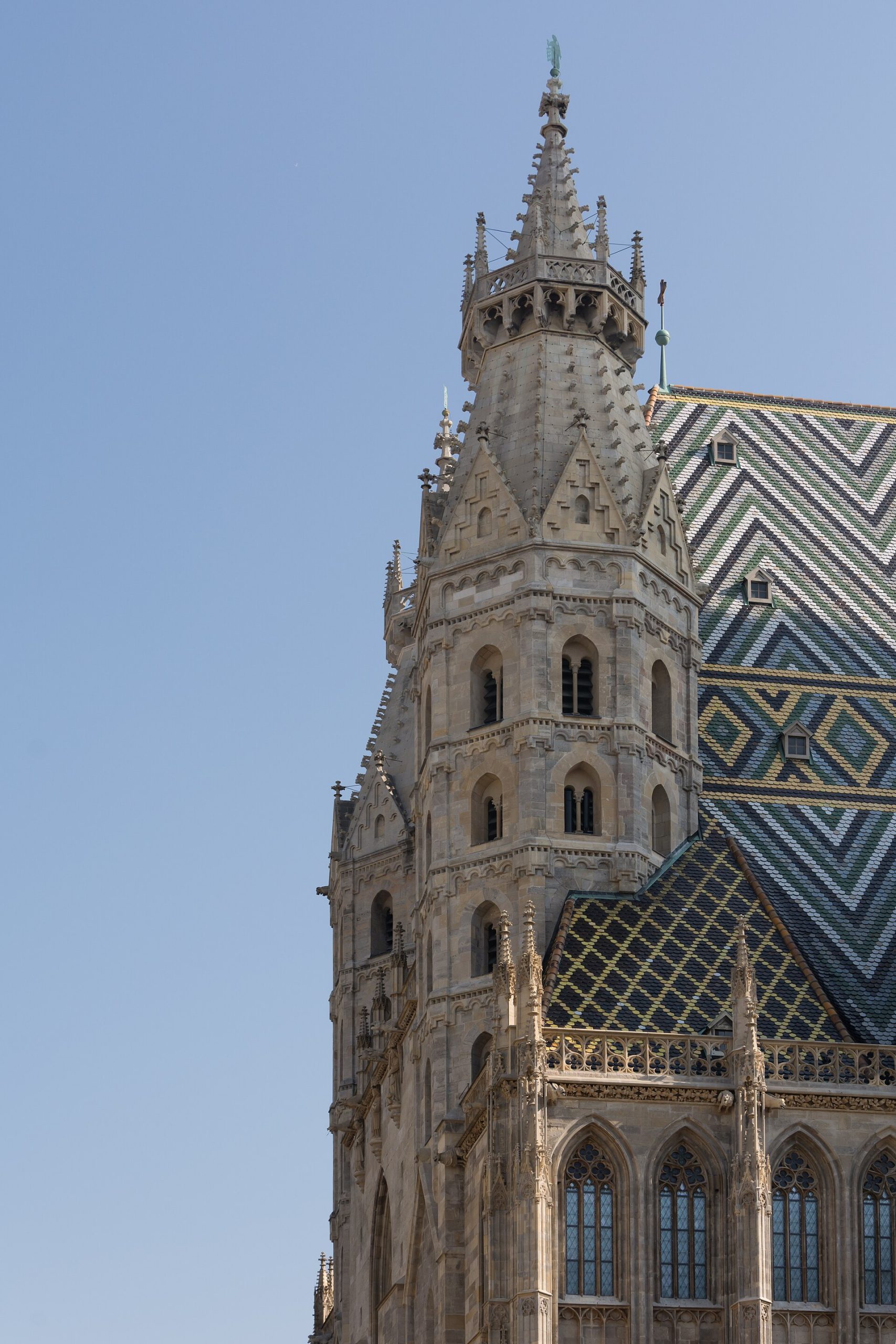
Walking into Stephansdom costs nothing. The nave stays open to visitors without a ticket during posted hours. Admission is charged for four things: the catacombs, the treasury, the South Tower, and the North Tower. Which tower to climb depends on time, fitness, and weather — the North Tower has an elevator, the South Tower is 343 steps on foot, and the views overlap more than most guides admit.
What is free inside Stephansdom?
The main body of the cathedral — nave, high altar, pulpit — is open without a ticket during visiting hours. Stephansdom is an active parish church, not a museum. Mass and prayer take priority over sightseeing, and tourist movement through the nave is restricted during services, a rule set by the cathedral’s own parish, the Dompfarre St. Stephan.
The tiled roof and the west-facing Riesentor, the Giant’s Gate, need no ticket to view from outside either. That includes Stephansplatz, the square in front of it, part of Vienna’s 1st district, the Innere Stadt.
What costs money at Stephansdom?
Four paid attractions sit inside or attached to the building. Each is ticketed separately, according to the cathedral’s own site, stephanskirche.at.
- Catacombs (Katakomben): a guided walk through the burial vaults beneath the choir. Entry is by timed tour only, no self-guided access.
- Treasury (Domschatz): vestments, reliquaries, and church silver on an upper floor. Self-paced, no tour required.
- South Tower (Südturm): the tall spire that defines the skyline, reached by an internal spiral staircase.
- North Tower (Nordturm): deliberately left unfinished, reached by elevator to a platform beside the Pummerin bell.
South Tower or North Tower — what’s the real difference?
The South Tower platform sits roughly 72 meters up. Getting there means 343 steps, single file, with no elevator option. It is the tower most guides point to for the wider view.
The North Tower elevator rises to roughly 60 meters, beside the Pummerin, one of the largest bells in Austria, weighing over 20 tonnes according to the cathedral’s own description. The climb is nearly instant.
The height gap between the two platforms is about a dozen meters. That is small enough that the tiled-roof pattern, and much of the city beyond it, is already visible from the North Tower. The South Tower adds altitude, not a different city.

Which combination should you actually buy?
The right choice depends on three things: how much time is available, physical fitness, and weather. There is no single correct answer, only a rule for each situation.
- Under 30 minutes, or raining: North Tower elevator only. The ride takes moments and skips the other paid sights entirely.
- 30 to 60 minutes, dry, average fitness: North Tower elevator plus the catacombs. Both run on timed slots, so the wait between them matters more than the climb itself.
- Over 60 minutes, fit, clear weather: South Tower plus catacombs. The stairs reward a clear day with a wider view over the Innere Stadt. Skip the North Tower — its lower platform already shows most of the same rooftop.
- Over 60 minutes, limited mobility: North Tower elevator plus the treasury. Neither involves stairs, and the treasury is self-paced.
- Traveling with children: North Tower. Timed queues move faster than a single-file stair, and there is less risk of a child stalling 200 steps up.
Do the combo tickets actually save money?
Sometimes. The cathedral’s own ticket office sells combination tickets bundling two or more of the four paid sights at a lower combined price than buying each separately, per stephanskirche.at. Which bundles apply, and at what price, changes over time. Confirm current combinations and pricing directly on the operator’s site before buying.
One thing does not change: the two towers are not sold together. Each is a separate structure with its own staircase or elevator, entered from a different point outside the building. Buying “both towers” means two transactions, not one.
How does this fit into a visit to the 1st district?
Stephansdom sits inside the historic center of Vienna, which UNESCO lists as a World Heritage site (UNESCO’s listing covers the wider Innere Stadt, not the cathedral alone). Most visitors reach it on foot from within the Ring, or by U-Bahn to Stephansplatz station.
For getting there and moving on afterward, the city’s transit runs on a zone-and-time-validity system rather than single point-to-point fares — a structure explained in full in how Vienna’s public transport fare system actually works. Details on planning a broader day around the cathedral sit in the practical planning hub, and other ticketed landmarks worth comparing against Stephansdom’s model are covered in the Vienna sights and museums guide.
Residents who pass the cathedral daily rather than visiting it once should also see how district boundaries and numbering actually work, covered in how Vienna’s district numbers work, and for wider patterns of city life, the living in Vienna hub and the getting around archive both go beyond single-site visits. Wien Tourismus, the city’s official visitor board, also publishes current practical notes at wien.info.
Access Vienna is an independent guide written from published, checkable sources. We have not visited the places described here and we do not publish personal recommendations or invented ‘local favorites’ — where something is singled out as notable, we say who says so. Opening times, fares, closures and prices change at short notice, so treat everything here as a starting point and confirm with the museum, operator or venue directly before building a day around it. We give no advice on visas, insurance, health or safety; use your own government’s official guidance for those.
Featured image: Photo by Uoaei1, source, CC BY-SA 3.0
