
Vienna is sold to the world as the city of music, which is true and almost always explained badly. The useful fact is not that Mozart, Haydn, Beethoven, Schubert, Brahms, Mahler and both Strausses worked here. It is that the institutions they wrote for are still running, still most nights of the week, and are cheaper to get into than nearly anyone expects.
This section covers how you actually get in: what a standing place costs, which ticket cannot be bought at any price, which buildings you can walk round in daylight, and where the composers ended up.
The cheapest way into the Staatsoper
The Vienna State Opera releases 567 standing places for every performance. They are priced at €13 in the balcony, €15 in the gallery and €18 at the back of the stalls — roughly the price of two coffees and a pastry, for the same performance the stalls are paying two hundred euro to watch.
Part of the allocation goes on sale online at 10:00 Vienna time. The rest are sold in person at the separate Stehplatz window on the Operngasse side of the building, which opens 80 minutes before curtain. Each standing place has its own subtitle screen at the rail, so the language of the libretto is not the obstacle it might sound like.
This is the single best-value cultural admission in the city, and it is worth being blunt about the consequence: there is no product to buy here and nobody to buy it from. You queue, or you refresh the page at ten.
The one ticket that cannot be bought
The New Year’s Concert is not sold. It is allocated by ballot, drawn by the orchestra itself, and applications are open only during February for the following year. The maximum is two tickets, and no amount of planning, spending or persistence improves the odds.
The rules are published by the orchestra and nowhere else is authoritative: see the Vienna Philharmonic’s own FAQ. Anyone offering you a New Year’s Concert ticket outside that draw is selling you something, but it is not what you think you are buying.
The rooms themselves
Most of these can be looked round in daylight without a ticket to any performance, which makes them the rare Vienna sight worth the detour even if the programme means nothing to you.
| Venue | Built | What it is |
|---|---|---|
| Staatsoper | 1869 | The house on the Ringstrasse. Guided tours run about 40 minutes, in German and English at minimum, taking in the auditorium and the imperial intermission rooms. |
| Musikverein | 1870 | Theophil Hansen’s Goldener Saal — home of the Vienna Philharmonic and the room the New Year’s Concert is broadcast from. Tours run roughly 45 minutes, around €10, less for students. |
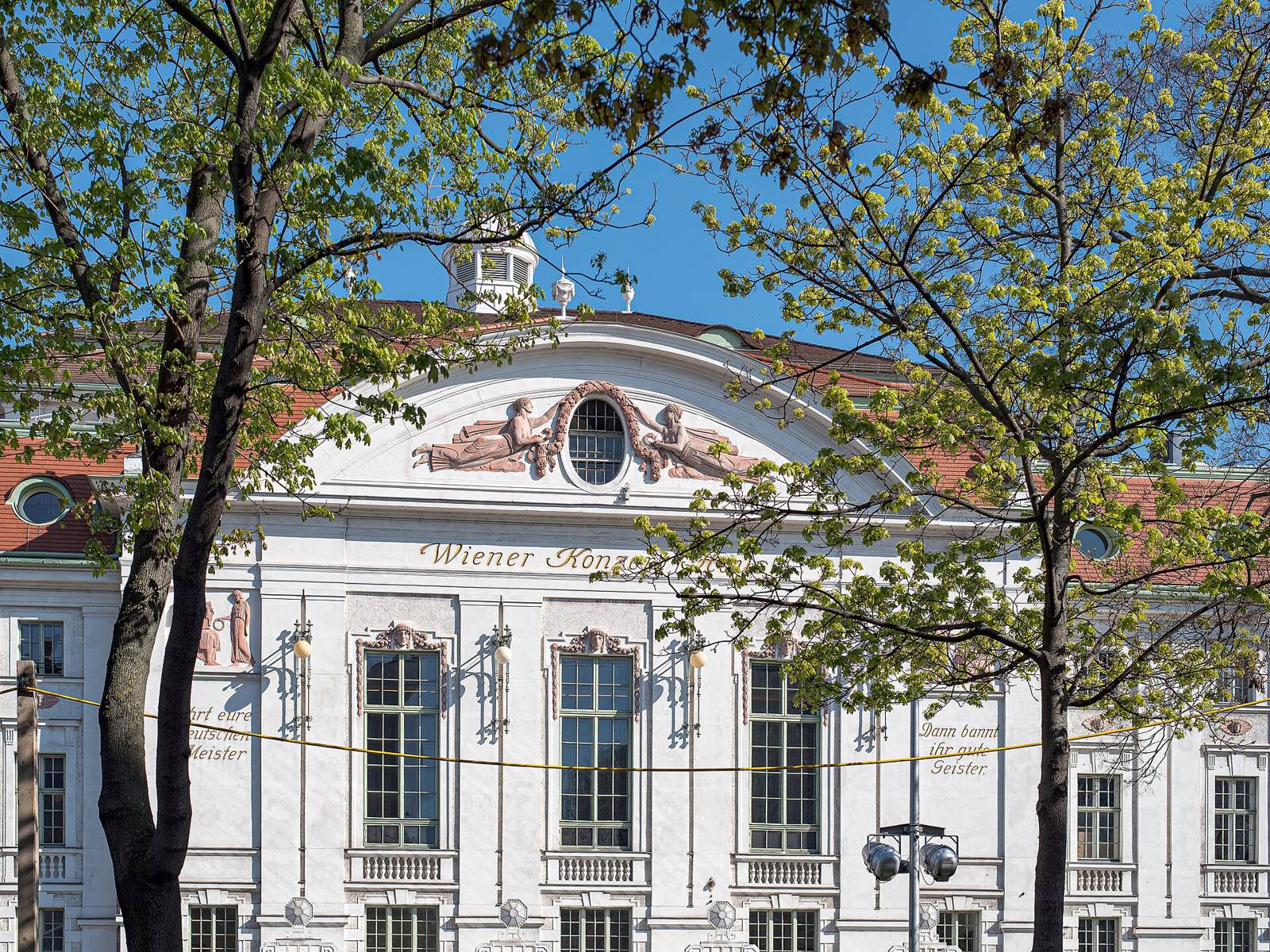
| Konzerthaus | 1913 | Fellner & Helmer with Ludwig Baumann. Four halls, the largest seating 1,840. A far wider programme than the Musikverein and generally the easiest of the big rooms to get into. |
| Theater an der Wien | 1801 | Beethoven’s only opera, Fidelio, was first performed here on 20 November 1805. Programmed as an opera house again today. |
| Volksoper | 1898 | Operetta, musicals and opera sung in German, with its own ensemble. Consistently the cheapest way into a full staged production. |
| Burgtheater | 1888 | Not music, but the same Ringstrasse building programme and the same logic: tours by day, and genuinely cheap seats high up. |
One practical warning: the Volksoper’s English-language pages were returning server errors when we last checked, in September 2026. The German schedule works normally.
Where the composers actually are
Not in the churches, mostly. The honorary graves are at the Zentralfriedhof, in Group 32A — Beethoven, Brahms, Schubert and the Strauss family, grouped together, with a Mozart memorial among them rather than a grave, since his burial place at St Marx is unknown.
It is a tram ride from the centre and free to walk into, which makes it one of the few things on any Vienna music itinerary that costs nothing at all.
What we are writing next in this section
These are in the queue and will appear here as they publish:
- How Staatsoper standing tickets actually work
- How you get tickets to the Vienna New Year’s Concert
- What the Musikverein is, and how you get into a concert there
- Where Vienna’s composers are actually buried
- Which Vienna composer apartments you can visit, and whether they are worth it
Prices, times and ticket rules on this page are as published for 2026 and were checked in September 2026. Confirm with the house before you build a day around any of them.
Access Vienna is an independent guide written from published, checkable sources. We have not visited the places described here and we do not publish personal recommendations or invented ‘local favorites’ — where something is singled out as notable, we say who says so. Opening times, fares, closures and prices change at short notice, so treat everything here as a starting point and confirm with the museum, operator or venue directly before building a day around it. We give no advice on visas, insurance, health or safety; use your own government’s official guidance for those.